 Flowers
 Mushrooms
 Bees
 Butterflies
 Monarchs
 How they change
 London
 Pittsburgh, Nashville, Kentucky, Atlanta
1 · The same for all of them
Four stages, every time
Every one starts as an egg the female lays on or near the plant her caterpillars will eat. The caterpillar eats, grows and molts, then becomes a pupa, and the adult comes out. Here it is for the monarch, the one I raise (more on the Monarchs page). Icons grow relative to each other, not to true size.
Tap a stage

Egg1.2 × 0.9 mmStage 1 of 9
Cream, taller than wide, with lengthwise ridges. Laid one at a time under a leaf near the top of the milkweed. The dark head shows through just before it hatches, about 4 days in.

1st instar2–6 mmStage 2 of 9
Pale, shiny and nearly see-through, with a black head and no bands. Fine bristles and tiny bumps where the filaments will grow.

2nd instar6–9 mmStage 3 of 9
Black, yellow and white bands appear. Look for the yellow triangle on the head, framed by two yellow bands. Filaments are short nubs.

3rd instar10–14 mmStage 4 of 9
Abdomen bands are darker and crisp, but the thorax is still mostly dark. Larger head triangle, longer front filaments. Drops and curls into a ball when disturbed.

4th instar13–25 mmStage 5 of 9
The thorax is now clearly banded. White spots show on the prolegs. Front filaments about 5 mm.

5th instar25–45 mmStage 6 of 9
Plump, with wide, velvety black bands and distinct white dots on the prolegs. Front filaments about 11 mm; the front pair of legs is smaller than the other two.

J-hangabout 1 dayStage 7 of 9
A full-grown caterpillar often wanders far from the milkweed to find a safe spot. It spins a silk pad, hooks its back end into it and hangs upside down in a J for about a day. Then it sheds its skin one last time, and a soft, pale green chrysalis appears underneath.

Chrysalis8–15 daysStage 8 of 9
Jade green with a black and gold band and gold dots, hanging from a silk pad by the black cremaster. The black, orange and white wings show through just before the butterfly emerges.

Adult3½–4 in wingspanStage 9 of 9
Orange wings with black veins and black borders dotted in white. A male has a small black spot on a vein of each hind wing; a female has none, wider veins, and often looks darker. Adults wait 3–8 days before mating. Summer adults live 2–5 weeks; the fall generation that migrates can live up to 9 months.
Sizes, timing and traits: Monarch Joint Venture. Egg and chrysalis appearance: Monarch Watch and Florida Museum. Adult size and marks: Missouri Dept. of Conservation; lifespan and mating: Monarch Joint Venture. J-hang: Monarch Joint Venture and University of Maryland Extension.
2 · Where they start to differ
What the caterpillars eat
A specialist's caterpillars eat one kind of plant. A generalist's eat many. Most of mine land in between: any plant from one family.
Specialists
One plant groupThe caterpillars eat one kind of plant and starve without it. It's why I grow milkweed for the monarchs.
- Monarchmilkweeds
 Milkweed tussock mothmilkweeds
 Great spangled fritillaryonly violets
In between
One plant familyPickier than a generalist, but any plant in the family will do.
 Black swallowtailcarrot family, plus rue
 Clouded sulphurpea family: clovers, lupine
 Silver-spotted skipperwoody legumes
 Tomato hornwormtomato family
 Fiery skippergrasses
 Sachemgrasses
Generalists
Many kinds of plantsTheir caterpillars eat from several plant families.
 Eastern tiger swallowtailtulip tree, ash, willow, cherry and more
 Variegated fritillaryviolets, maypops, purslane and more
3 · The last change
How they pupate
Every butterfly and moth goes through a pupa stage. Only butterflies call it a chrysalis; many moths wrap theirs in a silk cocoon or hide it underground. Here's how the ones on my cards do it. Tap a name to see its card.
- Hang upside down
A bare chrysalis hangs from a silk pad, after a J-hang.
 Hang upright in a silk belt
A bare chrysalis stands head-up against a stem, held by a loop of silk around its middle.
Black swallowtail · Eastern tiger swallowtail · Clouded sulphur
 Hide in a leaf shelter
Skippers pupate in the rolled leaf or grass tent they lived in, tied shut with silk.
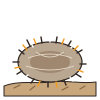 Spin a cocoon
A moth wraps its pupa in silk. This one weaves its own black, orange and white hairs into it.
 Dig in underground
No cocoon at all: the caterpillar burrows into the soil and pupates in a little chamber. Look for the jug-handle tongue case.
Sources: UF/IFAS Featured Creatures and the sources on each card.